Unwanted parking is one of those “small” problems that becomes a daily headache—blocked gates, customers losing access, residents arguing with strangers, and security teams wasting time. The fastest, most practical fix is simple: install a clear no-parking sign board that people can see before they stop.
But not all signs work. If the board is too small, fades in sunlight, isn’t reflective at night, or is placed where drivers miss it, it becomes decoration—not enforcement.
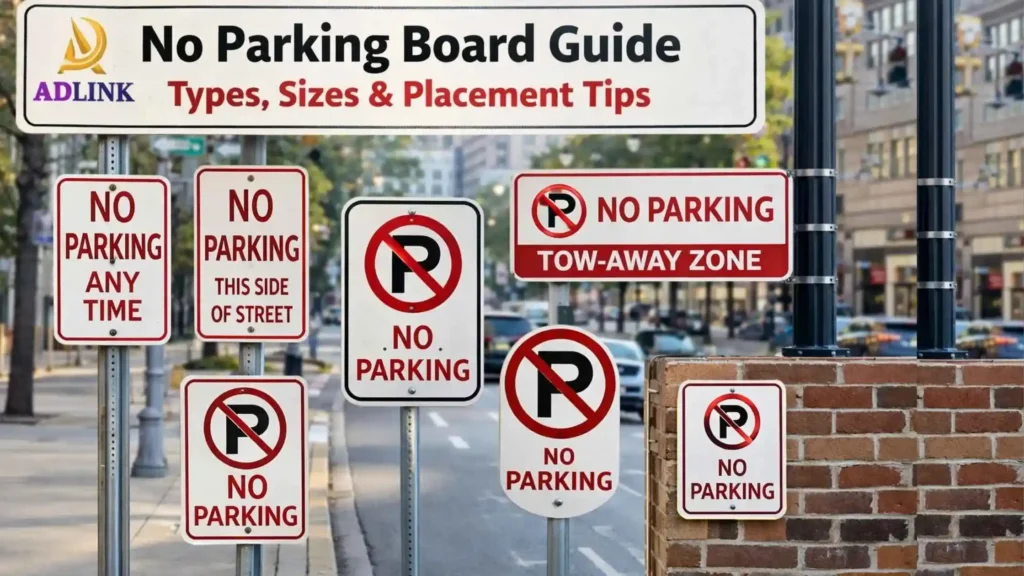
This No Parking Board Guide Types, Sizes & Placement Tips explains what to buy, what to print, where to place it, and how to choose the right design for Indian conditions. You’ll also learn about no parking board designs, no parking board printing, and what affects no parking board price—so you can stop violations without overpaying.
Why a No-Parking board works better than warnings
A printed board does what verbal warnings can’t:
-
- Sets expectations instantly (no confusion, no excuses)
-
- Prevents repeat offenders (consistent rules reduce “chance parking”)
-
- Supports enforcement (especially for commercial sites and gated access)
-
- Looks professional (important for businesses and societies)
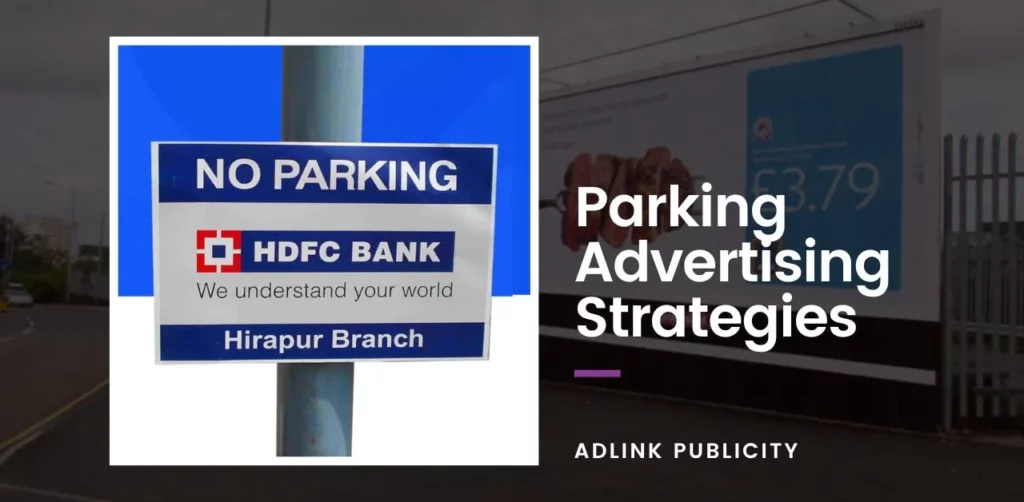
If you’re managing a busy entrance, installing a No Parking advertising board with clear messaging is often the easiest way to reduce conflict.
Types of no parking boards (choose by location and use)
The best board depends on where it’s installed and who it’s meant to stop. Residential boards (homes, societies, driveways) are designed to prevent blocking and keep entry/exit clear. A no parking in front of gate signboard is a common need in independent houses and societies.
Best use-cases:
-
- Driveways and gates
-
- Society entrances
-
- Basement ramps
Commercial no parking boards (shops, offices, warehouses)
For businesses, clarity matters: customers, staff, vendors, and delivery vehicles all need rules they can’t misinterpret.
-
- “Customer Parking Only” areas
-
- Loading/unloading zones
-
- Staff-only sections
-
- Fire lane/emergency access
Temporary boards (events, construction, short-term rules)
Useful for pop-up rules and contractor work zones. These should be affordable and quick to replace.
Materials that last in India (sun, dust, rain)
Your board’s life depends heavily on material. India’s heat and monsoon cycles can destroy low-quality signage quickly.
Aluminum (best long-term outdoor choice)
Aluminum boards are a strong pick for outdoor durability—ideal when you want a sign that lasts multiple seasons.
-
- Main gates and boundary walls
-
- Parking lot poles
-
- Commercial properties
Sunboard / ACP / PVC (budget-friendly and common)
These are widely used for no-parking board printing because they’re cost-effective and easy to print.
-
- Society corridors
-
- Indoor basements
-
- Short-to-medium term outdoor use
Reflective boards (must-have for night visibility)
If vehicles enter after sunset, reflective vinyl makes the sign readable in headlights—especially in narrow lanes and low-light parking areas.
Standard sizes + what to choose (visibility matters)
If the driver can’t read it in time, they’ll ignore it (even unintentionally).
Popular board sizes in India:
-
- 12″ x 18″: Most common; great for gates and parking slots
-
- 18″ x 24″: Better for extra text (timings, warnings, towing info)
-
- 24″ x 24″ or larger: Best for entrances, boundary walls, high-traffic areas
Simple rule: If your sign needs to be read from far away, go bigger and keep the message shorter.
No parking board designs that actually stop parking
Good design prevents excuses. Great design stops the car before it stops.
Use clear wording (keep it short)
-
- NO PARKING
-
- NO PARKING IN FRONT OF GATE
-
- CUSTOMER PARKING ONLY
-
- LOADING ZONE – NO PARKING
-
- NO PARKING – ENTRY/EXIT MUST REMAIN CLEAR
-
- Red + White is the most recognized “restriction” combo.
-
- Avoid light colors that blend into the wall.
Go with bold, simple fonts (no decorative text). People read signs in 2 seconds—design for speed.
Add arrows when needed
For long walls or shared spaces, arrows reduce “technical loopholes”:
-
- “NO PARKING BETWEEN SIGNS”
-
- Arrow left/right to define boundaries
This is also where no parking sign board advertising can help: clean branding + consistent design across multiple properties improves recognition.
Also Read: Top Election Campaign Materials Every Candidate Needs in 2026
Placement tips that stop violations
Placement is what makes signage effective.
For a gate or driveway
Install a no parking in front of the gate board:
-
- At eye level (approx. 4–5 feet)
-
- Near the entrance point
-
- Facing approaching traffic (not parallel to the wall)
For walls and shopfronts
Wall mounting works well when cars park directly facing the building. Add arrows for clarity.
For open parking lots
Post-mounted signs should be:
-
- At the head of the space
-
- Centered and unobstructed
-
- Repeated every few slots if the area is wide
Avoid these common placement mistakes
-
- Hidden behind plants or pillars
-
- Too far inside (cars block it)
-
- Too small for the viewing distance
-
- Mounted too high (drivers don’t notice)
No parking board printing (and “near me” buying tips)
If you’re searching for ” no parking board printing near me, use these checks before ordering:
-
- Is the print UV-resistant for outdoor sun?
-
- Are you getting lamination or reflective vinyl?
-
- Is the board thickness suitable for wind and heat?
-
- Will they include mounting holes/corner rivets?
For consistent quality across multiple sites, many facility managers prefer working with an established vendor like Adlink Publicity for standardized design, print, and installation support.
No parking board price (and what affects cost)
No single price fits all, because it depends on:
-
- Size (higher costs more)
-
- Material (aluminum > ACP/sunboard)
-
- Reflective vinyl (adds cost but improves results)
-
- Printing quality (UV/eco-solvent + lamination lasts longer)
-
- Mounting type (wall vs post, accessories, installation)
If you’re planning multi-location signage, bulk ordering typically improves value and keeps your branding consistent.
Cost of no parking board advertising
Some businesses use no-parking boards advertising to combine rule-setting with brand visibility (especially for shops, societies, clinics, and commercial buildings). Your cost of no-parking board advertising usually depends on:
-
- How many boards do you need
-
- Whether designs are custom-branded
-
- Placement quantity (single gate vs full property coverage)
-
- Material choice (reflective and aluminum raise cost but last longer)
If your property struggles with repeat violations, stronger signage is often cheaper than daily conflict and security management.
How to make a no-parking board
If you want DIY or want to brief a printer clearly, here’s how to make a proper board:
-
- Choose size (12×18 for gate, 18×24 for detailed rules)
-
- Pick material (sunboard/ACP for budget, aluminum for long-term)
-
- Write one clear message (avoid paragraphs)
-
- Use high contrast (red/white)
-
- Add arrows if needed (to define boundaries)
-
- Select finish (lamination or reflective vinyl)
-
- Add mounting holes (4 corners for stability)
-
- Install at eye level with proper visibility
If your goal is maximum effectiveness, professionally printed boards outperform DIY paper signs every time.
No parking sign board in Hindi
Here are practical Hindi versions people recognize quickly:
-
- यहाँ पार्किंग मना है
-
- नो पार्किंग
-
- गेट के सामने पार्किंग मना है
-
- प्रवेश/निकास के सामने पार्किंग मना है
-
- केवल ग्राहक पार्किंग
-
- लोडिंग ज़ोन – पार्किंग मना है
For mixed communities and commercial areas, bilingual boards (Hindi + English) often work best.
Conclusion
A good no-parking sign board isn’t just a warning—it’s a system that prevents confusion, reduces conflict, and keeps your property accessible. Choose the right type, pick a visible size, use proven no parking board designs, and place it where drivers can’t miss it. If you want help with buy no parking board, no parking board printing, or a branded no parking advertising board setup for residential or commercial no parking boards, reach out to Adlink Publicity to get the right size, material, and installation plan for your location.
FAQs:
For outdoor use, aluminum with reflective vinyl is usually the most durable and readable option, especially for gates, boundary walls, and parking lots.
Most gates do well with 12" x 18". If you need extra text like timings or warnings, 18" x 24" is easier to read.
It depends on size, material, reflective coating, print quality, and installation method. Bigger and reflective boards cost more but usually work better.
Place it where drivers naturally look—near the entry, at eye level, facing incoming traffic, and not hidden behind cars or plants.
If you meant RC hobby boats, choose an RTR electric boat with stable hull and simple controls. (If you meant “parking board,” tell me and I’ll tailor it.)
Use high-contrast colors (red/white), bold fonts, minimal text, and print on durable material with lamination or reflective vinyl.